05 – 8mm Elvis – An interview with author Vince Wright
In 1977, the king of Rock n’ roll, Elvis Presley, died. This also happened to be at the height of Super 8, and the king left a huge legacy in this format.
It is not very often we in the film collectors community are treated with a new hardcover book. But Vince Wright, a long time Elvis collector and former Derann employee, has just given us such a book dedicated to Elvis on 8mm.
In this new episode of the Humming Projector Podcast I talk to Vince about Elvis and his new book 8mm Elvis, a fantastic book for both avid film collectors and Elvis collectors who want to learn more about Elvis on this format.
As always, you can listen to the episode on our website. You can also find it on Spotify, Pocket Casts, Apple Podcasts and other podcast players.
Topics in this episode:
- Why the interest in Elvis?
- How did his death affect the Elvis community?
- How did he get the idea to write the book, and how was the process?
- The foreword by Ged Jones
- The cover design that have a clear resemblance to certain releases.
- What will you find in the book?
- Fan filming and preserving of the history
- What did Vince learn while working on this book?
- Where can you buy the book?
Links
- Buy the book at www.8mmelvis.com
- Elvis on Super8database
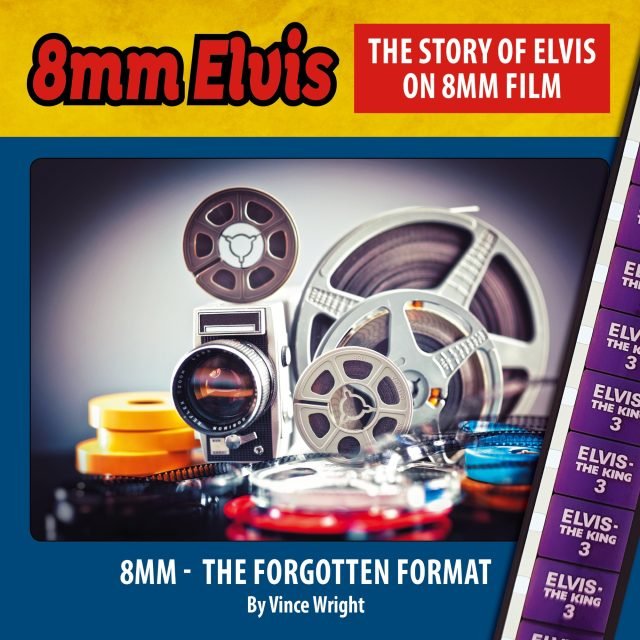
The book cover
In this episode
-
 Eivind Mork
Host
-
 Vince Wright
Guest
Chapters
Transcript
Welcome to another episode of the Humming Projector Podcast. Today we will talk about a celebrity that died in 1977. There were a few famous deaths that year, like Charlie Chaplin, John Crawford, wrote remarks from the Mark Brothers, Bing Crosby, Alan Reid, the voice of Fred Flintstone. But if you ask anyone to name a celebrity that died in 1977, I bet most people would name Ben King. Not a regent, but the king of rock n' roll, Elvis Presley. And with me today to talk about Elvis, I have an avid Elvis collector, Vince Wright. Welcome to the podcast, Vince. Thank you. Welcome to everybody listening. Hello. And Vince, you have written a new book that's called 8mm Elvis. And to introduce you a little bit, I can mention a few things I have learned about you recently. And that's that you have been a fan club branch leader. You have run Elvis events. You have hosted Elvis radio shows and podcasts. You are an 8mm collector. And you have also worked at Derann, a firm that most people would know about in this community, I guess. So let's start off. How did you get interested in Elvis? I think I've always been behind the times, I would always say. You know, I was an unusual kid of my age. I suppose like a lot of us here who liked the Laurel and Hardys. I liked the Chaplains, where I should have been more up to date. And musically, I was always stuck in the 50s. I loved all my rock and roll initially. And then I sort of, I was collecting that, but I was only a kid. So I didn't have the greatest budget. And then, of course, Elvis died and, you know, everything became available and it really became high profile. And it just took over. Yeah, and what fascinates you about Elvis? Why Elvis and not somebody else that was famous in the 70s? Well, I think you go back to the 50s. I go back to this, you know, the 50s was when they invented teenagers. And I love this whole idea. You know, we can listen to punk in the 70s, but it was all done before in the 50s, wasn't it? The rebel, you know, the parents didn't like it. And how dare you dress like that? And I just see that as Elvis died and punk came. It was like a rebirth. So I was really into this. I wasn't the rebel. I'd like to have been a rebel. I was incredibly boring. But I did have a quiff. But I liked the magic of the 50s. And then once I got into it, I found him a fascinating character. And he could sing anything. And so I do like a lot of other music. I like a lot of other movies. But I just got sucked into it, I think. Yeah, and for me, I was born four months before Elvis died. And for me, that can't remember anything. How did that, how did this death affect the Elvis community? I mean, he was, had been famous for 20 something years and everybody in the world knew who Elvis was. And when this happened, how was that? And how did that affect the Elvis community? Well, I think it was one of those, you'll always remember where you were when you heard the news, when people, you know, those that were around at the time, will remember it. So, it was huge. It was, people said to me, when Princess Diana died, it was like Elvis. It was in the papers, it was every program, it was every everything. So I think it was, it was like that. I'm not saying they were the same people, but the way the media the media treated it. It was that big. If you remember the Diana, Princess Diana death. It was, it was everything. It was everywhere. It was, every magazine had a couple of colour supplements. Everybody was selling badges. It was really just took over, took over the nation. And I think that was the thing that you realize there might have been the great 50s. And then there was some weird films, late 60s, that were a bit iffy, but we kind of, we kind of, we kind of re-found him. And I think when you said with Bing and Groucho dying at the same time, that was, there was a, you know, there was this, "Oh, they weren't the Marx Brothers great?" So it was, it was lovely that the nation picked up on these. Yes, and he had been doing several things. I mean, of course, he's known for his music, but he was also an actor. So, and he had started with his music and gone to acting and then back to music again. And so he had, I mean, he's famous for several reasons. And I guess people would probably have collected a few things before his death as well, but I would presume that his death would affect the collecting world of Elvis. So how was the collecting world of Elvis, the world of those that collected items and memorabilia from him, how was that in the late 70s? Yeah, that was where, you know, things were being reissued because they, you know, LPs that hadn't been records that hadn't been around for a while. So everything came out and, you know, we were still weren't quite up to VHS. So we weren't the video days. So the 8mm filled a little bit of a gap, but obviously it was pricey then. But, you know, people who were there from the 50s suddenly found that their collection would change hands at better money, you know, because there was a need for it. a bigger demand perhaps. Yeah. And when I was looking into this subject, I realized I hadn't been thinking about that before, but he died in 1977 and that's the prime time of Super 8, I would call it, yeah. So the timing was like perfect for the Super 8 world. I had never realized that before I started thinking about that now. Yeah, if you look at sort of '76 before he died, up to say 80, 81, the companies that put stuff out, whether they were legal or not, they were a license to print money, weren't they really? Yeah. So, you have had this interest for Elvis for a long time, and of course he was all over the press as you mentioned. But several years has passed since then. And how did you get the idea for the book? Was it something that you suddenly realized now, or have you been thinking about this? No, it's quite scary, because during COVID and lockdown, and there was nothing else to do, I got a box out of the loft, and it was all my research on this from the late 80s and early 90s, because I just collected it, and I made lists, and I bought catalogues, and I swapped and changed with people. So all my letters to collectors and, you know, I'll buy a lower from away from you, and you can buy GI Bleeds from him. I found all this, and while it was COVID and I had very little to do, I started putting it together, and I thought this could be a book. And I thought it might be a little pamphlet, a sort of a leaflet. And as I crossed the internet, I got to see people like, you know, like yourself, all over the world. People going, you know, "I've got this Italian version. I've got this Japanese version. I've got this." And you're going, "Wow." And it grew, and it grew, and it grew, and it grew. So, yeah, that's the best thing to come out of COVID, is it sparked this off. I'd been collecting in the, you know, in the early '90s, where people weren't so keen. I put an advert in the fan club and in Record Collector magazine, saying, "I want your Elvis 8mm." And, of course, people were thinking, "Well, I've got VHS. I don't need this rubbish." And, you know, I managed to get some really good deals. So that really, that just took off. And then I sort of got married, had kids and, you know, life got in the way. It all went on the backburner till COVID, really. And I can see in the book you have a list of contributors that have helped you, I presume, by providing material. And that list is impressively long. I presume you have learned to know a lot of people during this process. Is that correct? Yeah, I mean, certainly from, you know, I think Jed's, Jed's, Jed Jones's Duran page was great. And because I knew him from work and chatting to him, and he introduced me to, to people as well, that you suddenly that, but all the little Facebook groups, suddenly I could go, has anybody got this red fox box? Has anybody got this? And it was lovely that the community came together. And some people sold me stuff. Some people sent me nice pictures. Some people sent me a catalog or whatever. So it was, it was, it was lovely. And, and it is nice to see it now that it's a finished product. And yeah, you know, it's taken everybody to, to make it so. And, and I find some similarities from my own project. The other project I have, that is the Super 8 database, but because I do a lot of the same, like contacting people, getting help to, to collect material. So I, I could find myself in the little bit of the same situation that you have been in. That database is wonderful. I mean, I'm not just saying that because here, but that is, you know, when I think Jed pointed me in that direction at one point and you go, that's great. And, but, and it's one of those things that I go in looking for an Elvis thing. And then four hours later, I'm looking at Laurel and Hardy covers. And I go, I'm supposed to be doing something here, but I go, oh, do you remember that Tom and Jerry one? Oh yeah, that was my favorite Harold Lloyd. And then, yeah, it sucks you in, doesn't it? Yeah. That happens to me as well, even though I, I put all the data in with some help of our friends. And one of the friends you have got your help from, as you said, is Jed Jones. And he has written the foreword in the book, yeah. Yeah, because we worked together. It was nice that he was local. So, it was nice to be able to go around, have a cup of coffee, and then just go, "Do you remember who issued the trailer of Double Trouble?" And they go, "No." And I said, "Well, I've got this catalogue from Thunderbird." And then you go, "Oh, yeah." And then this happened and that happened. So, it was really nice to sort of grow and grow and grow that way as well. And it's nice that we didn't just talk about Elvis and we did talk about the old days and sort of reintroduced me to people I worked with as well. So that was nice. I need to describe your book a little bit. I sit with your book in my hand right now. And it's a beautiful cover, a hardcover, I need to say that. And it screams instantly Super 8 when I see this. I have seen this cover, let's put it that way, so many times, because to describe it to the listeners, it looks very familiar when you have seen the Elvis from Ken films. So I really like that. How do you come up with the design? I mean, I see you have your idea from the Ken films, but did you have any owner options? No, this is how I want to do it. Originally, I was looking at maybe doing it sort of A4 size, and more like an annual, like sort of, you know, the specials that came out every Christmas as a book for the dandy or the beaner or dandere or whatever. I was initially looking at that format. And then the printers where I went to, they sent me the options. And there was this sort of 8 inch square, was what they called medium square. And I went, well, that's exactly what I needed. And I thought about putting it in a white 600 foot box at one point, and just sort of scribble on the front. But I gave that idea up. But I loved the idea that it could sit next to, you can film 400 footers. And it would just sit there nicely. So once I got that, I worked on that. And me sister-in-law is a graphic designer. So I said, "Go and make this pretty." And she did, yes. And my compliments to your sister, because I really like this cover, I must say that. And the book has a vast vast amount of Elvis material, as we have been talking about, that you have collected a lot of material for this book. But what kind of content could the listener expect when they get this book? Well, because I did it, the 8x8, 400 foot sort of square, I like that I could put, when I had good quality pictures, I could put a cover, sort of nearly real size, so you could see it. And some of them are all all a bit creased and battered, but I kind of think that adds to the effect. And others are gorgeous and mint. But it is all the covers of what I would say is all the legal releases. And then the debatables are also there as well. But because a lot of things would have been a white box, I haven't just put a million pages of white boxes with Elvis through, you know, and that's just all that's written on the side in a pen or a rubber stamp. So I've been selective on those, but all the kind of, giving a taste of the variation of the, of the way Red Fox packaged them. So, you know, you couldn't, you couldn't just get every, every, every, every one. But it gives a taster of, of, of all of these. So it's really a little bit about the company to the non-8mm fan of, of who the companies were, what they released, in what format. Um, so things like if, if Double Trouble was on a trailer reel with other films, I've put what they were as well. They've probably all been cut up. You know, I, I only ever bought the Elvis trailer. I didn't buy the other two trailers that were on it unless it was something I particularly wanted, like The Wild One or Rebel Without a Cause or something. Yeah, and I, I think it represents the variety of the releases really well. As you mentioned, different types of, of covers, clamshells, cardboard boxes, all the sorts of things. And, but not only the physical representation of the film, but also the different types of content. You have digests. You mentioned library prints and, and, and presented really nicely with interesting facts about the releases and, and things like that. A really nice book to, to browse through, I must say. Oh, thank you. I mean, I'd never written a book before, so I didn't really have any rules. So I did the book that I wanted. You know, I've wanted this book since 1990. I waited for somebody else to write it and they didn't. So it's kind of, it's my baby. So thank you. That means a lot. And the digest from, about Elvis. I mean, normally for a digest, you would get the highlights of the of the movie, of the story of the movie, perhaps, or maybe some exciting scenes. With Elvis, the songs are pretty important, to say the least. How did that affect the digest, do you think? I think some work, and some are shocking. You know, you're always going to argue, why is that song missing from Tickle Me? Or why is that song missing from GI Blues? Or why do you only get a minute of it? But if you're playing with 17 minutes, you really are against the clock, aren't you? You know, trying to get it all in. So, at least they didn't all have that awful narration that was so often added to digests. And a different side of it. Now, we have talked a little bit about the official releases, but you mentioned other type of material available if you look for it. Because there are a lot of things that have been produced like bootlegs, but also fan filming like people have taking their camera and things like that. Yeah, I mean that is particularly huge at the moment because a lot of that sort of footage was changing hands, you know, before if it was the original footage and they've been digitally remastered and they're a DVD series of it now. So a lot of people in the Elvis world don't know the Elvis films. They only know these DVDs that have come out now with the fan footage. So it's an interesting time for that at the moment. Yeah, and I found that from those parts really interesting because I mean I knew a little bit about the Digest. I mean, I work with the Super 8 database. I've seen several of the covers, although I don't know necessarily everything about the releases itself. I've seen the covers, but this part was something I never have really thought about. So I was glad you included that in the book as well because that was an interesting part, I think. I think that a lot of this with the 8mm, where we say like when he died in '77, when he came to '78 and it was the first anniversary, everybody jumped on the bandwagon. So you would have things like three minutes of him at Madison Square Garden silent for $20 on a 50 footer. And these were like, you know, full page adverts in places. So they must have shifted boatloads of them. And you couldn't just sync it up with the LP because it was three minutes of an hour concert. And you can imagine if you filmed on 8mm, you pulled the trigger, you filmed 20 seconds, then you filmed a minute, then you filmed 20 seconds. So it is actually all over the place. But we didn't have YouTube, did we? We didn't have everything at the drop of a hat. No. And not everybody at the concert had a smartphone in the pocket either. So those that actually filmed it, I mean, finding something like that must be really special. Yeah. I mean, I've bought some that obviously people did a dupe copy. And you know, obviously you could go to the labs and either have an egg made or even just sort of, they just run copies of it. So potentially, there might only be two copies of that, but there might be hundreds, because you don't know who's put that out for that. If the amount of people I've talked to who collected 16mm, and they had a 16mm trailer of, say, Girl Happy, but they would copy, have it made at the lab, into an 8mm print so they could swap it with a friend, who would then, they would copy it and sort of, it was like sticking VHS machines together in a row and sort of losing another generation. You just got scratches. And also if your shin on ripped it apart, that's what was on the master. Yeah. And there, as you have said, it was a different time back then. How did that also affect the way the collectors worked? You have talked a little bit about that, but can you elaborate a little bit? Yeah. I mean, I feel that if you were an Elvis record collector, people kept them pristine and they wanted the right cover. I see so many here, even though they came in the clamshell box or what they might, well, we'll spool a few together. So it's all on a 1200 foot and the box went and it was kind of a disposable medium. I think just to a lot of people, it was a means to an end rather than collectible. Where now, you know, I can buy a GI Blues in a white box with a scribble on the front. But to me, I'm not interested in that. I want the proper box. So it's very odd that the market is different because some people just want to have GI Blues. It's in my collection. So I'm a bit, I'm a bit sort of a purist, I suppose, that I want the original packaging. So people will argue with me now and say they've made their own box, you know, they've cut up an LP cover and made a gorgeous box, but I haven't included it in the book because it wasn't legit. It wasn't the, you know, the one it was issued with. So collectors, I think there's, Elvis is a love him or hate him when the movies, you know, those 60s cheesy films were, well, I think like a Doris Day film or a Martin and Lewis. They were, they were, they were good fun, weren't they? As we, we mentioned at the start, you, you used to work at Derand and Derand got the deal for some of the Elvis films. Did you in any way get involved in that? I guess you must have been interested at least. Yeah, I mean, I was a little bit later on. So, uh, so, so I, when I was there, it was nice that the second hand market was where, you know, if, if, if a collection got bought in, I'd be having a, a sort of lean over and go, oh, like, uh, you know, there's a, there's a, there's a, there's a trailer for, uh, easy come, easy go there. And, uh, put that aside and I'll buy that one, put that aside and I'll buy that one. So, uh, once you get the first picks, that's nice. Yeah. But, but, but really when I was, you know, quite young then, when the features came in, they were still very expensive. So I didn't have any features for ages because that was just a different world to sort of a poor little chap. Uh, so I say like, so come 1990 when I was sort of putting adverts in, in things, it was nice to be able to get the, um, the Viacoms at a decent price in the proper box. And they looked, you know, they looked gorgeous. Um, so, you know, and we would show them at events sometimes as well. It was, it was really good. Films, uh, as we know, everybody that collects films knows that, uh, they degrade over time. Um, so, collecting them is, is, uh, it's something special. You, you, you know, the colors will last forever. I mean, we have better types of, of, of films that have come in, in later years, but you mentioned something in the book that I, uh, was thinking about. And that was that digitizing this when, when like fan filming shows up and digitizing it. How important that is, uh, before, uh, it degrades too much. Yeah, you know, this is the frightening thing that, you know, somebody's granddad went to see Elvis in 74, filmed it, and it got through out when he died. And you're thinking, you know, it's gone. Once it's gone, it's gone. Uh, but a lot of people did transfers early on, uh, and when VHS were, you know, there was points, point a camera at it. So they didn't transfer it digitally. And it's those, you know, are they still sitting in the loft that they need to get out and get digitalized? Because that, that 1992, uh, Handycam version of it is still not great, is it? No. So when you worked on this book, uh, did you learn anything new or get a new perspective on something during the work? Oh, oh yes. I mean, the things that I'd never seen before were great, sort of like an Italian release and Japanese releases in there. I'd never even heard talk of those. Uh, some of the German releases, um, I'd, I'd read about for years, but never, never got, uh, like the, the Elvis, the movie German one. So it's quite interesting to watch that now, dubbed, uh, because I'd never really got involved in any of the dubbed ones. Uh, it was all the, you know, the, you know, the Durans and the Viacoms. So that, that was interesting, but, but people, um, offering me films, uh, and films that weren't legitimate releases that people were buying to make it cheaper. They would buy one Elvis song in black and white on a 50 footer. Uh, and it should have been in color, but they just kept the costs down. So people were buying that. They, there were handheld, instead of a projector, these little handheld viewers that the non, you know, people who weren't keen on 8mm, they just wanted to see Elvis move, would have these weird little contraptions. And I bought one of those because I'd only ever heard of them and I've managed to get one on eBay and put a little 50 footer in it and with a battery. And it's shocking, but that's because we're spoiled now, isn't it? You know, but if, like I say in the book there, people that you could buy a Beatles stuff and they would give you that for like $4 on top. And that must have been brilliant, isn't it? To sort of go, you know, I could say that, but they were silent again. These little machines didn't have a soundtrack. So yeah, so things that were optical sound that I hadn't really come across before. So that's another section I've got to do. The scope, I never really got into scope on 8mm. I never had the equipment my mate did, but I never got down that route. So that was interesting to see a Blue Hawaii as it should be. And it just makes you wish that, you know, something like Blue Hawaii had been put out by Duran, like when they were doing the Disney's. You know, if it had come out in that sort of quality, that would have been amazing. But it's all what if again, isn't it? We've got Blu-ray now, however, anyway. Yeah, we're quite spoiled. You can find anything on YouTube if you want to look for it. But for me, that's part of the reason why I like to collect films on reels, because then I can get back to something where it really means something to find something, not just yet another movie of some sort. Finally, I found that I've been looking for it for like three years or whatever. For me, that was born in 1977. Perhaps I get a little taste of how it was like to find something back in the day. Yeah, that's it. I do think it's funny now when looking at it, the amount of people that think, you know, this 200-foot Laurel and Hardy must be worth 200 pounds because it's old. I don't think so. You know, it's a Walton, it's in a battered box. No.
Yeah, the difference of two reels, where one perhaps is a fan film and the other is a common release, that's quite different. So, when I got this book, I must mention, I got that as a birthday present from my parents. So, that was really nice. And if the listeners also want to have this experience of reading this book, where can they go to find your book? Well, the easiest way is go to my website, which is www.8mmelvis.com So, 8mmelvis.com and you can go on there. It's click whether you're Europe. I've sort of broke it down with the postage. So, it's British, Europe, America, rest of the world. So, you can click on and the postage has been calculated there. So, then it's just sit back and wait. And I will include a link to that page in the show notes, so the listeners can find it there. And a little bird has told me that you have already been ordering the second print of the book. Yes, yes. We've had those a couple of weeks ago now. The next batch came in, and it's lovely. I mean, it still just amazes me because, you know, I never thought I was... It was never a thing I was going to do, write a book. You know, it was never a dream or anything that I would seriously do it. You know, I played around with it, but it's out there. It's legit. It's got an ISBN number. It's in the British Library. So it's a real book. Yes, I'm so pleased about it with it. So for the listeners that might be interested in this book, yeah, the tip of the day would be to make sure you order this before the second batch is also out of print, because who knows how many batches Vince will do before it's empty. And when it's gone, it's gone. You know, when I first thought about doing this, I thought, well, who's going to be interested? And I thought, do I do a paperback? Do I do this? And I thought, no, it's the one book in my life I'm going to do. Make it sort of a glossy one. And then, I think, you know, it doesn't just get thrown on the shelf with a lot of other bits. But it's something to have. I'd say, yeah, if you like 8mm, have a read of it. If you don't know your 8mm, I've hopefully put enough in there to sort of educate the non-believers. Yeah, and I would say if you are into Elvis and not 8mm films, I'm sure you will learn something about film. But if you, like me, are into 8mm films and not necessarily know too much about Elvis, I also appreciated reading the book to learn something more about the king of rock n' roll. And it clearly is a labor of love. So anybody out there, I would recommend you buy this book from Vince Wright. Is there anything you want to add before we wrap up? No, I mean the only thing I really thought of is, looking into this, I've really got the bug for this. So if anybody thinks, oh you missed something, tell me. You know, if there is something out there that completely missed, I would love to hear about it. I did say what I've concluded and why, I've had Jailhouse Rock filmed off a TV, and then duped, and I've got, somebody sent me a 400 foot of that. So I've had the weird things, but you know, if that's what was out there, that's what was out there. But yeah, let me know. If you enjoyed this episode and want to follow us, you can listen to us and subscribe to our podcast using players like Pocket Casts, Apple Podcasts, Spotify, Google Podcasts, Amazon Music, Stitcher, Pandora, and YouTube. You can also use any podcast player supporting RSS. Go to our website, hammingprojector.com, to learn how to subscribe. You can also listen to the current and previous episodes on our website without any additional software. If you have any feedback for this episode, or a suggestion for a future episode, please send an email to feedback@hummingprojector.com. And with that, we have reached the end of this podcast. Go, run, and look for the book from Vince Wright. My name is Ein Möck, and with me I have had Vince Wright, and thanks for listening. Thank you very much for having me. I'll see you next time. I'll see you next time. Bye. See you next time. Bye. Bye. Bye. Bye. Bye. Bye.