20 – Special: Q & A with Phil Sheard at Blackpool 2025
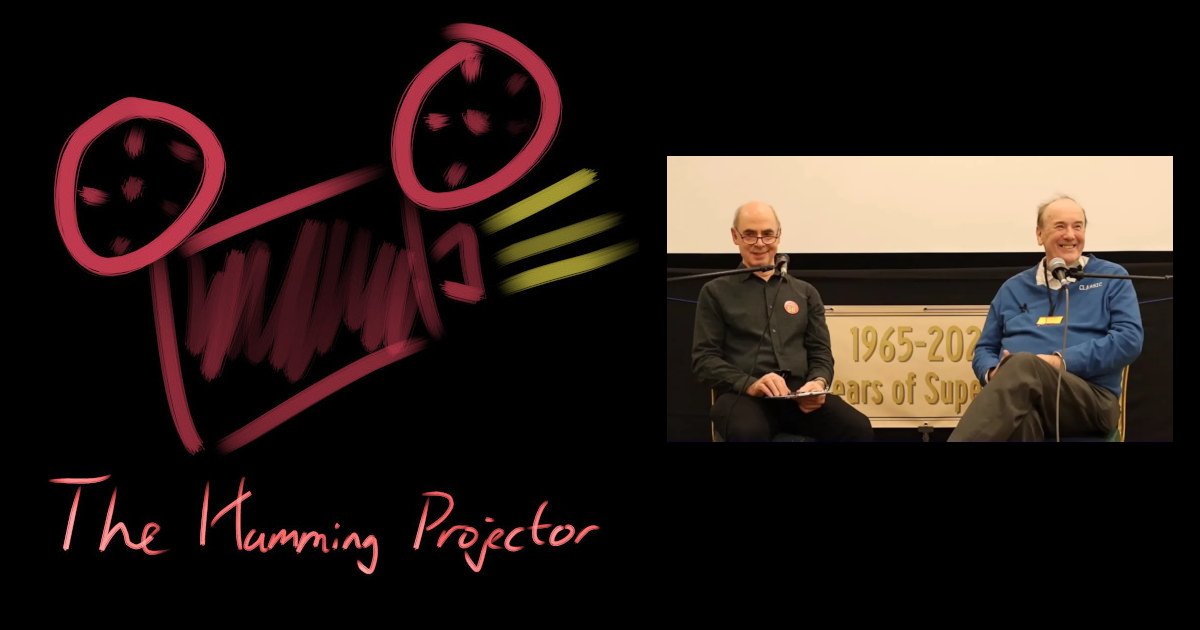
This special episode is a recording of the Q&A session with Phil Sheard, the owner of Classic Home Cinema, and Adrian Winchester. It was recorded at the Blackpool Film Collectors’ Convention, Sunday the 16th of November at the Grand Hotel in Blackpool.
A huge thanks to Phil Sheard, Adrian Winchester and the organizers for letting us publish this recording!
Links:
In this episode
-
 Eivind Mork
Host
-
 Adrian Winchester
Guest
-
 Phil Sheard
Guest
Chapters
Transcript
Welcome to this special episode of the Humming Projector Podcast. Every year I attend the Blackpool Film Collectors Convention in the UK, which is the place to meet other collectors in Europe. In the last years, the convention has had a Q&A session with a guest. This year's guest was Phil Sheard from the Classic Home Cinema. Phil shouldn't need any introduction, but for listeners overseas, Phil is running a physical shop selling his films, the last of his kind in the UK, and he has done so for many decades. The Q&A session was, as usual, led by Adrian Winchester. We are grateful to have been given the permission from both the convention and from Phil to release the complete recording of the Q&A that took place at the Grand Hotel the 16th of November 2025. This recording is also released as a video on Super8database's YouTube channel. And you can find a link in the show notes if you prefer to watch it as a video. Before we start, I will just mention that the dates for the next year's convention in 2026 has already been set. It will be the 13th to the 15th of November 2026. Everything you need to know in order to visit the convention next year can be found in the convention's homepage. Blackpoolfilmconvention.co.uk And a link to the page can be found in the show notes. You can also learn more about the convention in Episode 2, where I interview Simon McConway, one of the organizers, about the Blackpool convention. Super8database has also released its yearly video from Blackpool on YouTube, and you can find that link too in the show notes. And don't forget to visit the homepage of Phil Sheard's company, Classic Home Cinema, at www.classichhomecinema.co.uk. The link is included in the show notes as well. A huge thanks to Phil, Adrian and the other organizers for letting us share this recording with you. And with that, I will give the word to Adrian.
Good afternoon, ladies and gentlemen, and welcome to the Sunday afternoon Blackpool Film Fair Q&A slot. It's a great pleasure to be able to welcome Phil Sheard to this special Q&A because if you were here at the dinner last year, you'll know that we made a presentation marking Phil's many years of supporting Super 8 as a dealer, Classic Home Cinema releases. So it's great to have someone who is so closely identified in the film collecting world and, of course, who has been responsible for many releases. We're celebrating 60 years of Super 8. Obviously, Classic releases don't cover all that period, but a remarkably high substantial part of that period. So Thank you, Phil, for joining us. Perhaps if we could go back to the beginning in terms of your interest in film. Were you from a film-roving family? No, I lived in Rotherham, South Yorkshire. And I used to love to go out with my dad on the back of his motorbike and go look at the St. Nan shops at Hattercliffe in Sheffield. And they were always full of old projectors, mostly 9.5mm and things. I just used to be thrilled at that. And then I started buying on Sheffield Market copies of a magazine called Famous Monsters. And in the back were all these advertisements for movie films. So it got me drooling for that. So I bought a projector and found that I couldn't buy the films in the UK. But that's how I got started. I was 12 years old and that was 1963. So in those days, you would have been entirely limited to silent releases. Would these have been 50 foot reels? Yes, 50 foots, 200 foots and so on, silent stuff. Until 1970 when I changed the sound with Standard 8 sound. And then went on to Super 8 in '75. And then in 1988, started my own company. Between those times, I used to write in all the magazines quite frequently. You'll go look at your back issues and see the articles I did in those days. So, I've always been very keen to support the hobby. That is important, I think, for all the dealers to support the hobby. Even if you just come here, of course. But you need some support besides just selling films. And when you started, you mentioned you couldn't acquire the films. Were you importing films from America fairly early then? I was. I had a very good relationship with quite a few collectors in Germany and also in America. And what I used to do was buy UK releases and send them to them and they'd send me their releases back. And then I used to trade off those that I didn't wanted and that's how I got going, really. So I was interested in selling. And in 1988 when we started classic. I went to work with Derek Simmons who I was friendly with and he was very keen that we should have more dealers. We need more dealers nowadays, really. And he supported me in getting going and took me down to the labs and introduced me to everybody and so on. So we got going in 1988, which was 30 odd years ago, isn't it? Yeah. Well, we must talk more about the origins of Classic. But I remember, even before then, you would normally have a stall at the British Film Collectors' Convention, events like that. Well, we started going to conventions in '89, so Classic had actually got going. Prior to that, he used to do a bit of wheeling and dealing, as some of the dealers do nowadays. But officially it was '88, we got going with Classic and '89, we started doing the events. So, your first Classic release, was that 1988 or was there a little bit of a gap? It was about '89, '90 and the first one we did, I think, was a reel from a vintage musical in a sweet shop. I can't remember the name for the life of me now.
Oh, he was an American comic comedian, wasn't he? And it was a colour sequence from a black and white film which ended in colour sequence, so we produced this colour sequence. And we always have and still do use film as our master material. We don't tend to use video. And were the sales of that encouraging enough? No, I've never made any money releasing films at all. You don't. I think you went to one or two people who were in the hallway selling new films. You don't make any money. If I was to tell you that when I first started producing them, the retail price of a film was £23 for one real sound film. And I had to match that price to sell mine. The trade price I was paying was 9 pence per foot for a film. So a 200-foot film cost me £18 trade to make it. And I had then to pay VAT on top of that. A spool on top of it, a box, and so on. And so when we were selling at £23, I made absolutely nothing. We would order prints in batches of 20, and we never really sold many more than 40 of anything. There are some exceptions which did well, but there's no money to be made in releasing films. It's more of something to do for the hobby, which is important to keep it going. That's why I'm still releasing films today to support the hobby of film collecting. Don't make money at it. Now in the late 80s, I guess the number of labs wasn't quite as minuscule as today. Did you feel you had any option other than working with Duran in terms of where you could get films printed? I didn't know there were other options, but in fairness, I approached all the labs initially, and book films labs, for instance, they weren't interested in it unless I offered to order in quantities of over 100 for a per title. And I just couldn't afford to do that anyway. So, Derek would print it, I would print my films and I'd pay Derek for doing them, recording the sound and so on. That's how it first started. But we found later, it was cheaper to go to the labs in Germany, because their lab costs were half the UK lab costs. For instance, that one review that was costing me £18 when Durand did it, was costing me £12.50 from Germany. So, it was worth going to Germany to have them printed. Right. Now, you've known Steve Osborne for many years, haven't you? Who has been a key figure in releasing Super 8 in America via the Real Image, his company, isn't it? Yeah. Steve I've known for a long time and I've visited him in America a couple of times and we've had a good time. He was basically a very keen collector. He was a very keen collector producing a small magazine for some other collectors in America. And when I went to see him, he was buying a lot of films, as I was, from a company called Dave Thomas Films, which was an American, basically a big second-hand dealer. But his wife, Dave Thomas' wife, was very poorly and he wasn't able to continue the business. And Steve approached me and said, "What do you think I should do, Phil?" So I said, "Well, start a business up yourself. He'll take his business, because nobody is stiffing in." And he did, and he did very well with it. And as a result of that, he wanted to introduce some prints of his own, so I supported him in that and gave him my lab contacts. And indeed we've worked very closely together on releasing films in America as well as England. So, he's used my facilities to get some releases done. He is now making them himself, but they are from video, and I can't get my head around that one, I'm afraid. Releasing Super 8 prints from video. It's okay. You have to do it with trailers, for instance, and there are 35mm films available to make a master from. But, I'm not too happy in producing films from video. So, would it be true to say that, in terms of your amount of collaboration with Steve, that there were some releases that were pretty much joint efforts where you were working together, whereas some films he would have only released and some you would have? Right, yeah. Partly depending on... The beauty of that was that a lot of... there's a lot more available in America, source-wise. If we wanted, you know, we did a Captain America, if you might remember that one. We couldn't get a master for it in England. I mean, I remember Derek Simmons telling me in the days he released The Sound of Music, he got the rights to the film, but there were no masters at all in England for that feature. And that's the case in England. The labs didn't have anything really, whereas America can get just about everything, so being able to use Steve in America gave us access to a lot more materials. And working with the German labs gave us access to the European market and at the time we were in the common market. Anything that was sold in Europe could be sold in the UK as well, we didn't have any extra charges and so on. So access to both markets became easier. And you were sometimes acquiring masters that were clearly German because of German titles, so I guess there was somebody or people in Germany producing Super 8 releases. We did, in Germany they got access to a company called CIC, which did Paramount Universal also. All sorts of things. And they got the rights to that through what was originally marketing films. And they had things like Indiana Jones and The Last Crusade, The Lost The Dark and so on. Spider-Man I did. And what I did was get the English prints and use the sound and record them into English. So, which was then done at the labs in Germany. But because they were released in Germany, we could release them in England. That's what we did. Now you've referred to your first release. Of course, there must be a big difference in terms of the investment needed to release a feature on Super8. So, perhaps you could tell us about your first Super8 feature. Well, at the time we did our first release, I mentioned to you a few moments ago what it cost me to print 9p a foot. That's just printing cost. You have to make a negative from the 35mm Master. And for one real film, a negative will cost you about £700 or £800. So, if you imagine you sold 20 prints, were to multiply that out and add it to the cost of every print, the cost of prints would be tremendous. But, because I'm a legitimate business, I can write the cost of the negatives off against tax. So, that's how I was able to keep the prices down. But, nowadays, prints are being made and you're expected to pay the print cost and the negative cost upfront. So, they have deals that are selling at very, very high prices because they're not being able to write off the costs against the tax. So, what was your first Super 8 feature? The first feature, oh crikey, I've got a stand in my back now. We did ourselves in it from a negative, I got from Jeff films in America, was I think Ghost of Frankenstein. Then we did The Mummy, the Karloff version. And we went on from there. But before doing my own, I was working with both Terry's and Duran producing film. And the first collaboration with Duran was a western called, oh dear. Come on somebody who had to bought this one. Shane. Remember Shane? That was my master and the joint release with Duran. Yeah, then we did Star Trek Generations in scope. And then we also did Mask of Zorro in scope. Yeah. And you also released the original Universal Dracula, didn't you? Which was a bit out of the ordinary because you had a score that I think at that time was quite new. Was it Philip Glass? Yeah, the film Dracula version, the Lugosi one that was released, the video had been released with an auction in America for the original soundtrack or a new soundtrack with music effects added. And we used that one for our sound, I thought, because I thought the original version was almost a silent throughout, there was very little music in and so on. So, we used the soundtrack from the video, video on the Super 8 prints. That's a nice rarity to look out for. And so, you refer to being inspired by a famous Monsters magazines and so that interest in classic movie Monsters has been reflected quite a bit in the releases you put out of early Universal films. Yes, we did a lot of horror and sci-fi trailers and things. I particularly wanted to do a film called 'The Day the Earth Stood Still' and obtained a negative from America to print that. And we printed that and we had a lot of problems syncing the soundtrack. And Keith Wilton, who used to do the reviews in the magazines, pestered me and pestered me and said I must see this film, it's one of my favorites. So I let him have a print and that one wasn't correctly recorded. So I told him not to review it until I got the good one to him. He didn't review the faulty copy. And that destroyed all further sales. And it was a big disappointment to me that we didn't sell more copies of The Day of the Earth. Because it's one of my favorite films. Still got the master of course, but I don't think there's any point in releasing it now. Well I guess that's also a shame because you were considering This Island Earth, which would have been a great acquisition. We were offered a Technicolor Masters for This Island Earth, about 1997. And I advertised it at the BFCC when it was held at Ealing Town Hall. Put big posters up and so on, you know, if you're interested let me know. And nobody wanted a print, nobody. Another great sadness on my part, because I love the film, I love sci-fi and that sort of thing. Pretty good 50s. But we didn't get any orders, so we didn't print. If you'll understand that to release that would have cost about $4,000 or $5,000 for the negative. And then prints would have been retained at about $350 each. But we couldn't get a single order. Well, I'd like to give people a chance to ask some questions, so would anyone like to start us off? I'll tell you a few things while I'm thinking about it. Well, you already told you that we released a lot of films via Duran to start with. And we changed to labs in Germany, lots of reasons, probably finance. But I'd point out that when Derek Simmons fell ill in the late 1990s, he stopped working at the shop. He was still there in name but he stopped working at the shop and what he would do was lift soundtracks and record films. And he wasn't able to do that, nobody else was either. So that was one of the reasons I went to Germany, because I couldn't get my stuff recorded. But from that time on, 1998, we released more films than Duran did every year for 12 years. 12 years. And the last Duran releases on their last newsletter before the folders were all our exclusive German releases that they bought some of. So sadly, when Duran went, it ran because Derek went. I stopped working because I'm afraid that Derek's son saw me as a rival and not as somebody to cooperate with. It's sad, but that's really honestly the truth. I wasn't a rival. I would do anything I could for him, but there needs to be more dealers. There really does. Well, I think that's a shame and Classic didn't get the credit you deserved in that era. Although I think Film Labs North were starting to go downhill a bit and Duran's recording equipment had seen better days in terms of the striping. At the labs, when he was at Denim, we were there, we used to go to Denim. Well, that was rank initially, wasn't it, Denim? Yeah, it changed the film on North. Look, the 8mm printer was about 6-8ft long, wide, and about 5ft high. Loaded it with film cassettes and masters. But the film went through reels and sprockets like a projector until it met. And all those sprockets had retainers over them that held the film to the sprocket. But they were loose. So that machine was held together by rubber bands. It was little rubber bands holding the sprockets down. And it would fly off. And then damage the negative. And a lot of Durand's negatives you'll see in later days had these green marks all over them. I don't know if you saw that. That's because the negatives were devastated in the labs. They couldn't help it and they couldn't keep renewing negatives because they cost a fortune. So a lot of the later prints you'll see of these green marks. It came with a job. I remember one time when they were doing 'Wet Gate' once, 'That Gate' problems and you got 'Blobs' and… That's right, yeah. Certainly, one of my best releases I was really proud of, I got it from America, was a Warner Brothers cartoon called 'Carrot Blanca'. And it's brilliant. I know I'm ringing my own bells here, but it was brilliant. It's a spoof of 'Carrot Blanca'. We were using the Warner Brothers cartoon characters. And it was beautiful. The prints were beautiful, the sound and everything. And I got 20 prints, the first made, and sold them all. Ordered another 20 and they said, "Sorry, we've chewed the negative up." So it was only ever 20 prints made of that. And I could have sold a hundred. I don't mind. I think it was the last one you had. Probably, yeah. I would love to have released 50 or 100 of those and I would have ordered them as a second order. If you ever see it, buy it. That's all I can tell you. And the lab never offered to replace? Oh, no. They would never replace things, no. Disappointing though, isn't it? Because they should have given some sort of compensation. Well, you see, the master came from America and I had to send it back so they couldn't make a negative because they hadn't got the answer to make the negative from. I'm sure it's caused you quite a bit of frustration over the years that Super8, so many things can go wrong in the course of producing a top quality print with good sound and no damage or anything. It must sometimes feel a bit of a miracle when something turns out perfectly. Yes, it's a miracle when things turn up just for that. I have a couple of new releases showing. A couple of new releases shown today and I've got two more which I'll probably arrive on Tuesday at my shop. Because they're in customs, I've had to pay the duty on it and so they'll arrive in a package on Tuesday probably there. A trailer to the new Superman film in scope and a one reel special from the Batman TV series of the 1960s which is very, very interesting. without saying that. You'll see they're related, it's very interesting. And the next films we're doing are some extracts, digests and trailers to the Thunderbirds TV series. They should be popular. So Phil, did your trailer reels, you used them to produce, did they sell well? Some did. Later ones, I tried to theme them together. What I wanted to do with trailers, put a trail on, put a trail on, and always put a "coming soon" to come next week or whatever, and at the end of the reel, an intermission sign, trying to give you value for money. So we did that as often we could, but with modern trailers it was more difficult later because they didn't sell. We'd usually put two or three in a reel to try and fill a reel up, thinking in my innocence that that would be a way to sell a full reel. It didn't work. You've got quite a few of your original House of the Baskervilles. Yeah, all those. And they're the ones I like, yeah. Those Hammer Double Bills were great. Yes, yeah they were. But I would imagine the most we'd ever do was 40. The most. So is your main interest 50s and 60s? My personal for horror and sci-fi is probably the, for sci-fi the 50s. Yeah. And for horror I'll be a little bit older. Black and white stuff. And the Hammer Horror, The Brides of Dracula, I was going to release that full length. There were no takers to that. Derek Simmons wanted it but he wouldn't pay. So, I used to borrow the negatives. You have to pay to do this. And Derek wouldn't pay for Rides of Dracula. That's my favourite Hammer film.
I have a 16mm. Anyone thought of a question they'd like to ask? When you create, when you get the 35mm Master, when you create a negative, is it a 35mm egg you're creating? No. What happens is, I work and edit the 35mm print, and then watch it. That's what I want when I see it. That's okay, that can go to the labs. It goes to the labs. They produce a 16mm negative from that 35mm. And that is a very expensive process. And from that 16mm negative, we produce either 16mm prints, which we can do 8mm prints, which we can do from it, or 8mm, Super 8mm prints, and they are printed side by side. So it's sprocket hole, picture, sprocket hole, picture. It's then split down the middle and so, you know, striped and so on. The lab does the slitting, does it? You don't do that? Well, yes, I do do it. The labs wanted to buy my splitter, which came from Perry's, funny enough, and when they closed down, I bought all their stuff and all their sound recording stuff. And, erm, I bought their Bell & Howell Slitter. Derek wanted that. He would have killed for it, I think, but he didn't get it. I've still got it, so, I can do splitting in the shop, yeah. Erm, I spent a lot of my early years spending all my hard-earned cash on buying out companies like Crestor Electronics, we did their striping service. Perry's Movies, we took all their lab equipment and things. But, you know, you've got to be paid for. It's good to know that this process can still be done today. Yes. Would you love there to be a UK lab that's handling Super 8 again? Because I know that might seem a bit of a far-fetched dream, but there has been a sense of revival in terms of film use. I've seen labs offering 16mm services. My problem with producing prints is not with getting a print from a lab. It's getting the sound recorders onto the film. If we were to record it, as some are doing on projectors individually, the cost is phenomenal. It really is. You didn't have the PERIES sound recording equipment by any chance? Yes, I did, yeah. Have you tried using that, then, for any relief? I have. I've used it. And since that time, I've taken it to the tip. Through lack of use, you know. I'll just touch upon something that's maybe slightly controversial, but some of you will know that there has, at times, been a certain amount of debate amongst collectors with regard to prints from the German lab, because I think in the days of acetate prints, there was a sense that at least some of the prints had a bit of a yellowish cast. But more recently, there were prints that looked very nice, but you could argue that maybe you're not getting really nice bright reds or bright greens. There's a kind of sense of them looking a little bit turquoise with colours that don't exactly match what you would see theatrically. And so I wonder, Phil, if you have any view on that. Because to just give one example, I remember, as I'm a big Hammer fan, I bought your... It was the reissue of Hammer's Dracula. There was a BFI released, a kind of restored version around 2007, and you had the trailer to that, which I bought on Super8. And I thought it had that slightly sort of yellowish look. But then I bought a 16mm one, which looked perfect to me. So I think that's sometimes a bit of a difference in colour between the lab's 16mm prints and the Super8 prints. And so I wondered if you have any theories whether you agree? I'm sure that could be the case. Adrian has mentioned this to me before we came in. I have no knowledge of any faulty prints being raised with me. In all the time I was dealing with the German laboratories, or I'm doing, I've never had a problem with the prints. If there is a problem, and you have a problem in any print, you should be able to return that print to the dealer and say, "This isn't right, can I have my money back?" That's what I do. And that's the best guarantee you'll ever get. Every lab, every lab will have problems printing now and again. They'll get a stain on it or tint it a little bit. In the heyday of Duran, they used to make a heck of a mess of films, frequently. And what Derek would do was sell them off as white box specials. Well, that's all very well until it comes to today, when people want to sell me a copy of a feature film, which they don't mention to me that it's a white box special. So I finish up buying a green one, or whatever. And I get robbed, you know. So all labs dealing through physical photographic medium will suffer with colour changes now and again. But if it's not right, the lab and the dealers should change it. So, had they brought that matter to my attention at the time, I could have been able to raise it with a lab, but nobody ever, ever told me. But, it's been on some DVD forums that all films now, they're complaining that they've got a teal effect. That's a blue-green tint to them. It just seemed to be a fad that was going around that. I thought that was the way to present it. Some films, at times, have been, I know, deliberately slightly tinted to be reproduced better on Super 8. One example of this is Independence Day, the film of that. The feature. It was printed deliberately slightly blue. But that was by Duran. And complaints are made about that at the time. But as it was done, it stopped the colour changes problems. Well, it's certainly been intentional in some of the Alien series films. I think they do look a bit bluish. And that was the intention. So no one would have any reason to complain about that if that's the genuine theatrical look. Sadly, film fades with age, a lot of it. Some stocks don't, some notes do. If you printed it blue, as certain people release these films a little bit with a blue tinge, it might help later down the road in the fade problem. And I think that might be why it's done. Also, they might look okay with tungsten, but anyone's using a Xenon. Exactly. It does. Derek, when he got Duran, he sold his films quite reasonable prices at the time. When prices were reasonable, he was reasonable. But he would search the world for film stock to print onto and then print on it. And so you can finish up with, you can finish up with a feature film, which you think is going to be superb, and one reel of it is red. Because that reel was printed on a cheaper stock. And that's why it's sometimes tinted them blue. Knowing that they were going to fade. It didn't tell you that at the time, but that's why it was done. Some of the Walton ones were like that because the video apps used whatever was available. Indeed. Well that seems to have been very common with airline prints because practically everything was low fade by I think the end of 1983 and yet there were airline prints like Little Shop of Horrors made a few years later than that and virtually all airline prints seem to have faded. These optical sound features. Well yeah because the labs were printing the airline prints were using the stock up that was possibly going to fade later because there's no need to make it low fade because they weren't designed to last more than five years. And it's sad because those prints looked stunning when we were acquiring them, some of the best prints I've ever seen and so if only they had been low fade they'd be prized collector's items. Well, when I started talking about how I got into doing this, prior to being a dealer, I used to buy films from America. I used to buy optical sound prints on Super 8. And I used to get all the James Bond features, which we had been shown on the aeroplanes. And the prints on those were stunning, but they later went red. And I used to get them from a guy in Florida called Ray Coates, somebody might not remember him. And they were beautiful. I got Dr. Neuf, Russia With Love, Thunderball, all these were beautiful Super 8 prints. Now, they've all gone print! Sadly, we should wrap this up very soon, but does anyone have a last question they'd like to ask before we do? Let me, just before you ask the questions, make a request to you. I try to give something back to the collectors by giving them what they want, even if it's making boxes, which is expensive in itself. If it's making brackets for scopes. I make things and do things for the hobby. And I think it would be nice if more people were to tell me what they want. I can count on one hand, on each finger, the number of times I've had a letter saying, "Can we have this please?" And I have to reply of course. But nobody tells us what they want to see. So that in our next Baxter releases, which I've told you what they're going to be, I'm doing the thinking because they might sell. But nobody tells us, and they need to talk to your dealers, and support your dealers' efforts, buy the magazines that we do and all sorts, and keep in touch. That's what you need. And if you do that, Super8 will last it even further. Now there was a question towards the back if… Why do landmarks come out green? Why do they come green? Why is it green? Because it cuts into the film stock itself. So it's not a black line, it's carving it in. One side of the film is acetate or polyester and the other side is image. And it cuts into the image usually and that fills with green. It depends which side the film is scratching. And it can be that they put on, the emulsion is a red blue and green layer and it scratches through the layers. That's right. That's right. It's a heavier scratch, yeah. And finally, I think there's a gentleman over there who had a question. Out of all the films you tried to get your hands on, which was the one that got away? Which was the one that got away? Well, the ones I've missed out on, we didn't get deals on, was the first one was This Island Earth. Another one was, oh dear, Hello Frisco, Hello, which is a Fox musical, which I enjoy the old Fox musical type things. And probably those are the only two I think. We were trying to do Harry Potter at one time, on Super 8, the first one, but they didn't turn it out either, because they couldn't get it sorted with the labs and the owners. In Europe. It's interesting. You should read the articles I've written in my magazine about how the rights to films are acquired and how a lot of rights for Super 8 were acquired. We've done a number of articles about former dealers and former businesses, how they enter business. One of the best stories is how marketing film in Germany got to release a lot of films without the knowledge of the high ups at the film studios in America. In fact, they were quite shocked when they opened the big real magazine and magazines like that and saw big adverts for things like Saturday Night Fever and Grease. They didn't know they got the rights to them. And how those rights came to be given is quite a funny story. I dare not release it on video, I'm afraid. But the rights were required because everyone was doing everybody else a favour and some of the favours included girls. Thank you. Well that's probably a good time to draw things to a conclusion. But I will just say, if you've never been to Phil's shop in Cleethorpes, it has to be seen to be believed in terms of the staggering quantity of film there. So if that's something you haven't do, head there particularly when there's one of the open days or the August sale weekend because you'll have a fantastic time. I'll just conclude by saying thank you very much Phil, it's been fascinating hearing your stories, so many thanks for being a part of this year's convention.
Thank you.